Khóa học
IELTS Online
IELTS Online
Giảm đến 18%
Đăng ký ngay
Mục lục [Ẩn]
Khi ôn tập IELTS Reading, việc luyện kĩ năng giải đề qua các đề thi thật là một cách hiệu quả giúp bạn tăng band điểm nhanh. Bài viết này sẽ giúp bạn giải đề thi IELTS Reading Cambridge IELTS 16 – Test 3 “Roman shipbuilding and navigation” với đầy đủ đề bài, câu hỏi, đáp án chi tiết kèm giải thích rõ ràng. Đây sẽ là tài liệu hữu ích để bạn ôn luyện và nâng cao kỹ năng Reading, sẵn sàng chinh phục band điểm mục tiêu trong kỳ thi IELTS.
Roman shipbuilding and navigation
Shipbuilding today is based on science and ships are built using computers and sophisticated tools. Shipbuilding in ancient Rome, however, was more of an art relying on estimation, inherited techniques and personal experience. The Romans were not traditionally sailors but mostly landbased people, who learned to build ships from the people that they conquered, namely the Greeks and the Egyptians.
There are a few surviving written documents that give descriptions and representations of ancient Roman ships, including the sails and rigging. Excavated vessels also provide some clues about ancient shipbuilding techniques. Studies of these have taught us that ancient Roman shipbuilders built the outer hull first, then proceeded with the frame and the rest of the ship. Planks used to build the outer hull were initially sewn together. Starting from the 6th century BCE, they were fixed using a method called mortise and tenon, whereby one plank locked into another without the need for stitching. Then in the first centuries of the current era, Mediterranean shipbuilders shifted to another shipbuilding method, still in use today, which consisted of building the frame first and then proceeding with the hull and the other components of the ship. This method was more systematic and dramatically shortened ship construction times. The ancient Romans built large merchant ships and warships whose size and technology were unequalled until the 16th century CE.
Warships were built to be lightweight and very speedy. They had to be able to sail near the coast, which is why they had no ballast or excess load and were built with a long, narrow hull. They did not sink when damaged and often would lie crippled on the sea’s surface following naval battles. They had a bronze battering ram, which was used to pierce the timber hulls or break the oars of enemy vessels. Warships used both wind (sails) and human power (oarsmen) and were therefore very fast. Eventually, Rome’s navy became the largest and most powerful in the Mediterranean, and the Romans had control over what they therefore called Mare Nostrum meaning ‘our sea’.
There were many kinds of warships. The ‘trireme’ was the dominant warship from the 7th to 4th century BCE. It had rowers in the top, middle and lower levels, and approximately 50 rowers in each bank. The rowers at the bottom had the most uncomfortable position as they were under the other rowers and were exposed to the water entering through the oar-holes. It is worth noting that contrary to popular perception, rowers were not slaves but mostly Roman citizens enrolled in the military. The trireme was superseded by larger ships with even more rowers.
Merchant ships were built to transport lots of cargo over long distances and at a reasonable cost. They had a wider hull, double planking and a solid interior for added stability. Unlike warships, their V-shaped hull was deep underwater, meaning that they could not sail too close to the coast. They usually had two huge side rudders located off the stern and controlled by a small tiller bar connected to a system of cables. They had from one to three masts with large square sails and a small triangular sail at the bow. Just like warships, merchant ships used oarsmen, but coordinating the hundreds of rowers in both types of ship was not an easy task. In order to assist them, music would be played on an instrument, and oars would then keep time with this.
The cargo on merchant ships included raw materials (e.g. iron bars, copper, marble and granite), and agricultural products (e.g. grain from Egypt’s Nile valley). During the Empire, Rome was a huge city by ancient standards of about one million inhabitants. Goods from all over the world would come to the city through the port of Pozzuoli situated west of the bay of Naples in Italy and through the gigantic port of Ostia situated at the mouth of the Tiber River. Large merchant ships would approach the destination port and, just like today, be intercepted by a number of towboats that would drag them to the quay.
The time of travel along the many sailing routes could vary widely. Navigation in ancient Rome did not rely on sophisticated instruments such as compasses but on experience, local knowledge and observation of natural phenomena. In conditions of good visibility, seamen in the Mediterranean often had the mainland or islands in sight, which greatly facilitated navigation. They sailed by noting their position relative to a succession of recognisable landmarks. When weather conditions were not good or where land was no longer visible, Roman mariners estimated directions from the pole star or, with less accuracy, from the Sun at noon. They also estimated directions relative to the wind and swell. Overall, shipping in ancient Roman times resembled shipping today with large vessels regularly crossing the seas and bringing supplies from their Empire.
Questions 1-5
Do the following statements agree with the information given in Reading Passage 1?
In boxes 1-5 on your answer sheet, write:
TRUE if the statement agrees with the information
FALSE if the statement contradicts the information
NOT GIVEN if there is no information on this
1. The Romans’ shipbuilding skills were passed on to the Greeks and the Egyptians.
2. Skilled craftsmen were needed for the mortise and tenon method of fixing planks.
3. The later practice used by Mediterranean shipbuilders involved building the hull before the frame.
4. The Romans called the Mediterranean Sea Mare Nostrum because they dominated its use.
5. Most rowers on ships were people from the Roman army
Questions 6-13
Complete the summary below.
Choose ONE WORD ONLY from the passage for each answer.
Write your answers in boxes 6-13 on your answer sheet.
Warships and merchant ships
Warships were designed so that they were 6…………………………….. quickly. They often remained afloat after battles and were able to sail close to land as they lacked any additional weight. A battering ram made of 7……………………………... was included in the design for attacking and damaging the timber and oars of enemy ships. Warships, such as the ‘trireme’, had rowers on three different and moved 8………………………………
Unlike warships, merchant ships had a broad 9.…………………………….. that lay far below the surface of the sea. Merchant ships were steered through the water with the help of large rudders and a tiller bar. They had both square and 10.…………………………….. sails. On merchant ships and warships, 11.…………………………….. was used to ensure rowers moved their oars in and out of the water at the same time.
Quantities of agricultural goods such as 12……………………………... were transported by merchant ships to two main ports in Italy. The ships were pulled to the shore by 13……………………………... . When the weather was clear and they could see islands or land, sailors used landmarks that they knew to help them navigate their route.
Dưới đây là bảng đáp án chi tiết:
|
1. FALSE |
8. levels |
|
2. NOT GIVEN |
9. hull |
|
3. FALSE |
10. triangular |
|
4. TRUE |
11. music |
|
5. TRUE |
12. grain |
|
6. lightweight |
13. towboats |
|
7. bronze |
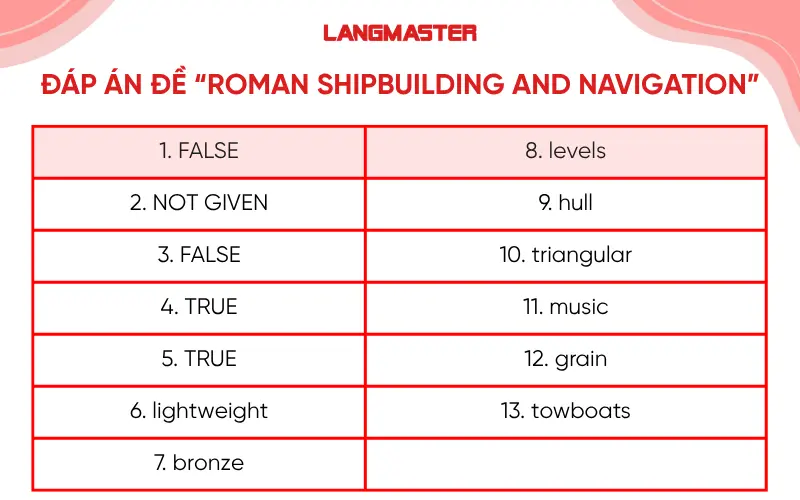
Đáp án chi tiết 1-5
1. The Romans’ shipbuilding skills were passed on to the Greeks and the Egyptians.
“The Romans were not traditionally sailors … who learned to build ships from the people that they conquered, namely the Greeks and the Egyptians.”
Giải thích: Người La Mã học kỹ thuật đóng tàu từ người Hy Lạp và Ai Cập, chứ không phải truyền lại cho họ → False.
2. Skilled craftsmen were needed for the mortise and tenon method of fixing planks.
“Planks used to build the outer hull were initially sewn together. Starting from the 6th century BCE, they were fixed using a method called mortise and tenon, whereby one plank locked into another without the need for stitching.”
Giải thích: Đoạn văn chỉ mô tả cách hoạt động của phương pháp mortise and tenon (“one plank locked into another without stitching”) nhưng không nói gì về việc cần thợ lành nghề hay không → Not Given.
3. The later practice used by Mediterranean shipbuilders involved building the hull before the frame.
“... Mediterranean shipbuilders shifted to another method ... which consisted of building the frame first and then proceeding with the hull.”
Giải thích: Câu hỏi nói “hull before frame” → ngược hoàn toàn với nội dung trong bài (frame before hull) → False.
4. The Romans called the Mediterranean Sea Mare Nostrum because they dominated its use.
“Rome’s navy became the largest and most powerful in the Mediterranean, and the Romans had control over what they therefore called Mare Nostrum meaning ‘our sea’.” → True
5. Most rowers on ships were people from the Roman army.
“... contrary to popular perception, rowers were not slaves but mostly Roman citizens enrolled in the military.” → Hầu hết là công dân La Mã phục vụ trong quân đội → True.
Đáp án chi tiết 6-13
6. lightweight
“Warships were built to be lightweight and very speedy.”
→ Chỗ trống: “Warships were designed so that they were ___ quickly.” →lightweight.
7. bronze
“They had a bronze battering ram, which was used to pierce the timber hulls or break the oars of enemy vessels.”
→ “A battering ram made of ___” → bronze.
8. levels
“The ‘trireme’ ... had rowers in the top, middle and lower levels.”
→ “... had rowers on three different ___” → levels.
9. hull
“They had a wider hull, double planking and a solid interior for added stability.”
→ “... merchant ships had a broad ___” → hull.
10. triangular
“They usually had two huge side rudders ... They had from one to three masts with large square sails and a small triangular sail at the bow.”
→ “... had both square and ___ sails.” → triangular.
11. music
“In order to assist them, music would be played on an instrument, and oars would then keep time with this.”
→ “... ___ was used to ensure rowers moved their oars in time.” → music.
12. grain
“The cargo on merchant ships included ... grain from Egypt’s Nile valley.”
→ “... agricultural goods such as ___ were transported...” → grain.
13. towboats
“... be intercepted by a number of towboats that would drag them to the quay.”
→ “... The ships were pulled to the shore by ___.” → towboats.
>>> XEM THÊM:
Khi bước vào hành trình giải đề IELTS Reading, việc xây dựng vốn từ vựng theo một lộ trình khoa học là yếu tố then chốt để cải thiện band điểm. Bài viết này mang đến danh sách từ vựng IELTS Reading quan trọng trong bài “Roman shipbuilding and navigation” giúp bạn tăng tốc độ đọc hiểu, nâng cao khả năng phân tích thông tin và từng bước đạt kết quả tốt hơn ở kỳ thi chính thức.
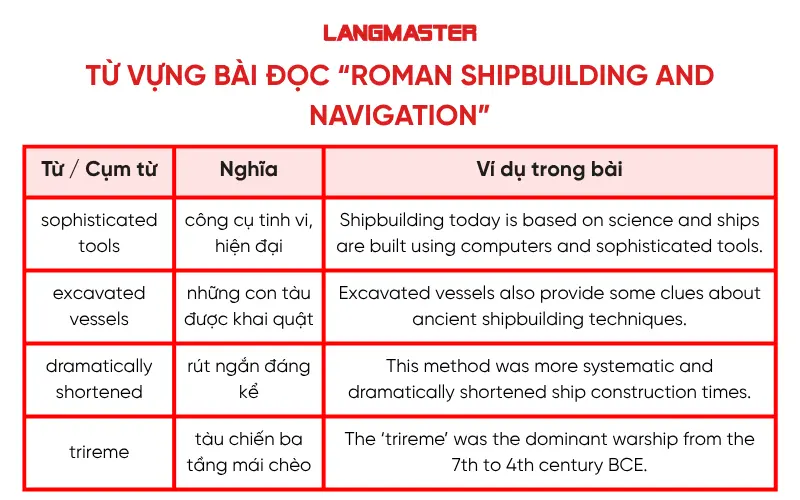
|
Từ / Cụm từ |
Nghĩa |
Ví dụ trong bài |
|
sophisticated tools |
công cụ tinh vi, hiện đại |
Shipbuilding today is based on science and ships are built using computers and sophisticated tools. |
|
estimation |
sự ước lượng, phỏng đoán |
Shipbuilding in ancient Rome, however, was more of an art relying on estimation, inherited techniques and personal experience. |
|
excavated vessels |
những con tàu được khai quật |
Excavated vessels also provide some clues about ancient shipbuilding techniques. |
|
mortise and tenon |
mộng và lỗ mộng (kỹ thuật ghép gỗ) |
They were fixed using a method called mortise and tenon, whereby one plank locked into another without the need for stitching. |
|
dramatically shortened |
rút ngắn đáng kể |
This method was more systematic and dramatically shortened ship construction times. |
|
ballast |
vật nặng dùng để giữ thăng bằng tàu |
They had to be able to sail near the coast, which is why they had no ballast or excess load and were built with a long, narrow hull. |
|
battering ram |
đầu tàu bằng đồng dùng để đâm thủng tàu địch |
They had a bronze battering ram, which was used to pierce the timber hulls or break the oars of enemy vessels. |
|
trireme |
tàu chiến ba tầng mái chèo |
The ‘trireme’ was the dominant warship from the 7th to 4th century BCE. |
|
V-shaped hull |
thân tàu hình chữ V |
Unlike warships, their V-shaped hull was deep underwater, meaning that they could not sail too close to the coast. |
|
rudder |
bánh lái |
They usually had two huge side rudders located off the stern and controlled by a small tiller bar connected to a system of cables. |
|
towboats |
tàu kéo |
Large merchant ships would approach the destination port and, just like today, be intercepted by a number of towboats that would drag them to the quay. |
|
pole star |
sao Bắc Cực |
Roman mariners estimated directions from the pole star or, with less accuracy, from the Sun at noon. |
>>> XEM THÊM:
Khi luyện đề IELTS Reading “Roman shipbuilding and navigation”, không ít thí sinh cảm thấy khó khăn trong việc xác định dạng câu hỏi và áp dụng từ vựng học thuật đúng ngữ cảnh. Để cải thiện kỹ năng làm bài và tăng band điểm Reading, người học cần có chiến lược luyện tập khoa học, kết hợp cùng lộ trình học tập rõ ràng.
Hiểu được nhu cầu này, Langmaster đã thiết kế các khóa học IELTS online cá nhân hóa, giúp học viên xây dựng nền tảng vững chắc. Với sự đồng hành sát sao từ đội ngũ giảng viên giàu kinh nghiệm, học viên sẽ được sửa lỗi nhanh chóng trong vòng 24 giờ và định hướng phương pháp ôn luyện hiệu quả, từ đó nâng cao tốc độ đọc hiểu và chinh phục mục tiêu IELTS một cách bền vững.

Tại Langmaster học viên được:
Coaching 1-1 cùng chuyên gia: Học viên được kèm riêng để xử lý điểm yếu, quản lý thời gian thi hiệu quả, tập trung cải thiện kỹ năng chưa vững và rút ngắn lộ trình nâng band IELTS.
Sĩ số lớp nhỏ, 7–10 học viên: Giáo viên theo sát tiến độ từng bạn, tạo môi trường học tương tác, nhiều cơ hội trao đổi và nhận phản hồi chuyên sâu.
Lộ trình học cá nhân hóa: Thiết kế dựa trên trình độ đầu vào và mục tiêu điểm số, kèm báo cáo tiến bộ định kỳ để đảm bảo học viên phát triển đúng hướng.
Giáo viên IELTS 7.5+: Chấm chữa bài trong 24 giờ, giúp học viên nhận diện lỗi sai nhanh, cải thiện rõ ràng từng kỹ năng và tăng tốc đạt mục tiêu.
Thi thử định kỳ chuẩn format: Mô phỏng áp lực thi thật, giúp học viên làm quen với thời gian, phân tích điểm mạnh – yếu và điều chỉnh chiến lược học.
Cam kết đầu ra – học lại miễn phí: Trung tâm đảm bảo kết quả học viên đạt mục tiêu, giúp yên tâm theo học mà không lo “thi mãi không qua”.
Học online linh hoạt – chất lượng như offline: Có bản ghi để xem lại, tiện lợi cho người bận rộn, tiết kiệm thời gian và chi phí mà vẫn đạt hiệu quả cao.
Hệ sinh thái học tập toàn diện: Cung cấp tài liệu chuẩn IELTS, bài tập online, cộng đồng học viên và đội ngũ cố vấn đồng hành, giúp việc học liên tục – hiệu quả – định hướng rõ ràng.
Đăng ký học thử IELTS Online miễn phí ngay hôm nay để trải nghiệm lớp học thực tế, kiểm tra trình độ và nhận lộ trình học tập hiệu quả, giúp bạn thành thạo kỹ năng IELTS Reading và chinh phục mục tiêu IELTS!
Khi ôn luyện đề IELTS Reading “Roman shipbuilding and navigation”, học viên không chỉ nắm vững đáp án đúng mà còn phát triển khả năng phân tích theo từng dạng câu hỏi một cách logic. Việc kết hợp từ vựng học thuật trong ngữ cảnh thực tế giúp ghi nhớ hiệu quả, đồng thời mở rộng vốn từ cần thiết cho kỹ năng đọc, chinh phục band điểm IELTS hiệu quả.





Các dạng bài phổ biến và tiêu chí chấm điểm IELTS Reading chi tiết nhất: Multiple Choice, Matching Information, Matching Headings,... và hướng dẫn chiến lược làm bài hiệu quả

Những sai lầm khi luyện IELTS Reading bao gồm: dịch từng từ, đọc hết cả bài, không đọc câu hỏi trước, không quản lý thời gian, không nắm vững kỹ năng paraphrase, viết sai chính tả
![Giải đề IELTS Reading: A brief history of humans and food [full answers]](https://langmaster.edu.vn/storage/images/2025/09/20/a-brief-history-of-humans-and-food-ielts-reading-answers.webp)
Giải đề thi IELTS Reading “A brief history of humans and food” kèm full đề thi thật, câu hỏi, đáp án, giải thích chi tiết, và từ vựng cần lưu ý khi làm bài.

Tổng hợp IELTS Reading tips hay nhất giúp bạn đọc nhanh, nắm ý chính và xử lý thông tin chính xác, tự tin đạt điểm cao trong kỳ thi IELTS.
![Giải đề IELTS Reading: The importance of law [Full answers]](https://langmaster.edu.vn/storage/images/2025/09/22/55.webp)
Giải đề IELTS Reading “The importance of law” kèm đáp án chi tiết, từ vựng quan trọng và bí quyết luyện thi hiệu quả để nâng cao band điểm.





Hơn 16 năm kinh nghiệm, đào tạo thành công 800.000+ học viên
Phương pháp giảng dạy hiện đại, học viên tiến bộ rõ rệt
Lộ trình học chuẩn quốc tế, phù hợp với nhu cầu thực tiễn
Giáo viên đạt chuẩn Quốc tế với chất lượng top đầu thị trường, giàu kinh nghiệm
Học online linh hoạt, cam kết đầu ra bằng văn bản

![Giải đề IELTS Reading Growing more for less [FULL ANSWER]](https://langmaster.edu.vn/storage/uploads/original/2025/10/22/growing-more-for-less-ielts-reading-answers.png)

![Giải đề Nature or Nurture IELTS Reading Practice test [FULL ANSWER]](https://langmaster.edu.vn/storage/uploads/original/2025/10/22/nature-or-nurture-ielts-reading.png)
![Giải đề IELTS Reading: How deserts are formed [Full answers]](https://langmaster.edu.vn/storage/uploads/original/2025/10/22/ielts-reading-how-deserts-are-formed.png)